
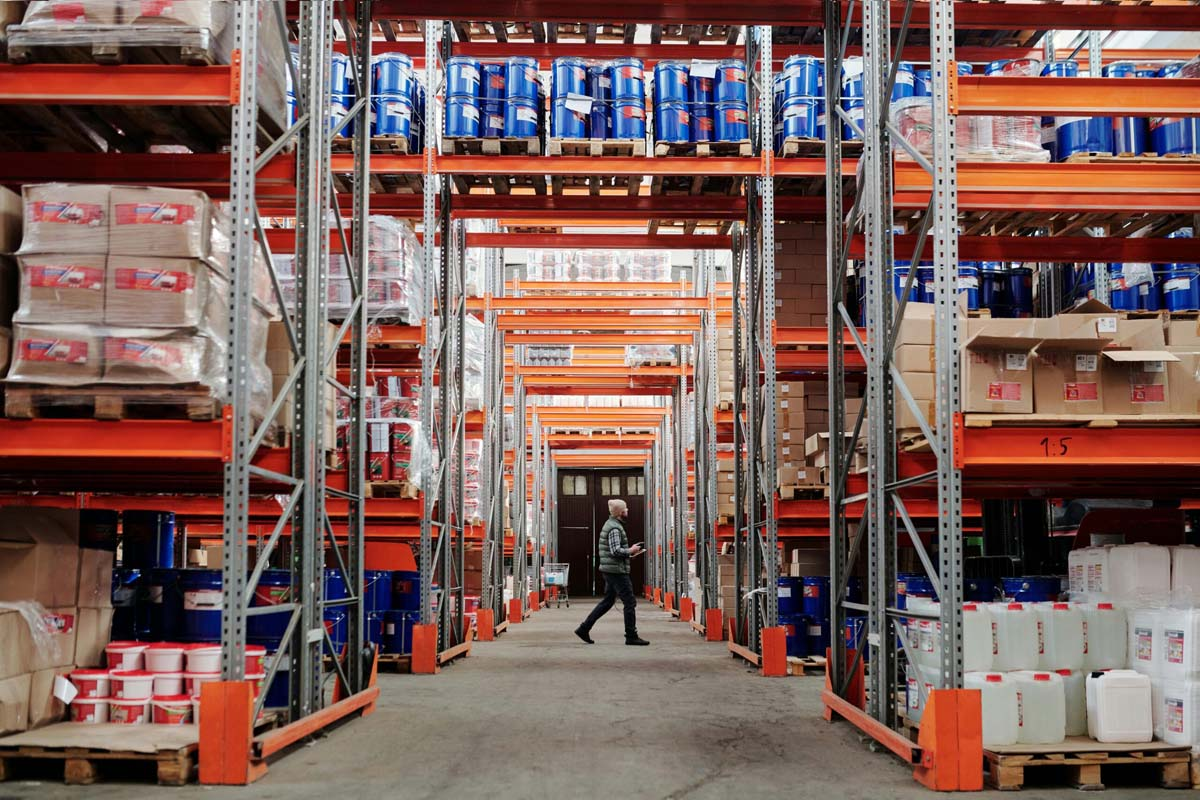
Imagine you run an e-commerce store selling fitness gear. Instead of picking and packing a yoga mat, resistance bands, and a water bottle separately, your warehouse pre-assembles them into a ready-to-ship kit. That’s warehouse kitting in action; grouping individual items into pre-packaged “kits” or sets to streamline order fulfillment.
But kitting isn’t just for e-commerce. It’s used in healthcare, manufacturing, and even automotive industries to speed up production and reduce errors.
And when done right, kitting can significantly cut labor costs, improve warehouse efficiency, and enhance the customer experience.
In this article, we’ll break down what warehouse kitting is, its benefits, and a step-by-step guide on how it works. We’ll also round up common challenges businesses face with kitting, and how to overcome them.
What Is Kitting in a Warehouse?
Warehouse kitting involves pre-assembling individual items into ready-to-ship kits, reducing the need for separate picking and packing. Instead of fulfilling orders piece by piece, warehouses group related products into a single unit, streamlining the fulfillment process.
Chris Gherardini, CEO of Turnkey Technologies, in the Kitting Business Processes Best Practices podcast, describes kitting as:
“The simplest definition of a kit is you’re grabbing stuff, throw it in the box as it goes out the door. It’s not assembled, it’s not manufactured, it’s not pre-built. But it really is a process where you’re grabbing a bunch of components, and typically it’s one line item on a sales order that has all these sub-components. It’s got a price, and it’s got all these little guys underneath it that have costs.”
This strategy is widely used across industries to cut costs, improve order accuracy, and enhance the customer experience. And many companies use kitting to gain a competitive advantage:
- Hoffmann-La Roche AG: The Swiss pharmaceutical company has automated the assembly of patient kits for clinical drug trials. By implementing an automated kitting process, they efficiently allocate medications and placebos to individual patients and groups in predetermined quantities, bundling them into personalized patient kits. This automation enhances precision, reduces manual errors, and increases efficiency in clinical trial preparations.
- Youth To The People: The Los Angeles-based skincare brand partnered with Aeronet Worldwide to optimize its order fulfillment. By adopting kitting strategies, they efficiently pre-assembled skincare products into kits, streamlining fulfillment for major retailers like Sephora, Nordstrom, and Anthropologie. This approach allowed them to process 800–1,000 shipments daily, with a significant increase during peak periods.
Kitting vs. Bundling
Although kitting and bundling both involve grouping products together, the terms are used differently in supply chain management and retail.
Kitting refers to creating a specific, pre-grouped set of items to be used together or shipped together. This is often done for assembly or order fulfillment. For example, a warehouse might kit a printer, ink cartridges, and a user manual into one set ready for shipment.
Bundling, on the other hand, often involves offering a set of items together as a promotional offer, like a “buy one, get one free” deal. The goal of bundling is to encourage customers to purchase more by offering a discount or added value.
In short, kitting focuses on preparing specific product sets for operational efficiency, while bundling is a marketing strategy aimed at boosting sales.
Kitting vs. Assembly
While both kitting and assembly involve working with multiple components, they serve different purposes in production and logistics:
Kitting is the process of gathering and pre-assembling items before they are needed for a larger project or shipment. It doesn’t usually involve modifying or altering the items themselves.
For example, a kit of automotive parts for assembly is simply packaged together without any changes to the parts.
Whereas assembly typically involves combining or altering individual components to create a finished product. It may include adding screws, wiring, or other elements that modify the components for a specific purpose.
In essence, kitting is about grouping pre-existing items, while assembly involves creating something new from individual parts.
Benefits of Warehouse Kitting
Warehouse kitting isn’t just about organizing inventory, it has plenty of other benefits too. Let’s look at some of them:
1. Faster Order Fulfillment & Lower Labor Costs
Kitting eliminates the need for workers to pick and pack items individually, drastically cutting down fulfillment time. This efficiency reduces warehouse labor costs by minimizing unnecessary handling, so the staff can focus on higher-value tasks like quality control.
2. Improved Inventory Accuracy & Management
With kitting, warehouses track pre-assembled kits instead of multiple individual SKUs. This simplifies stock management, improves forecasting accuracy, and reduces the risk of stockouts or overstocking, so businesses can maintain leaner, more efficient operations.
3. Reduced Shipping Costs & Optimized Packaging
Pre-packaging items into kits allows warehouses to use appropriately sized boxes, reducing dimensional weight charges and packaging waste. This leads to lower shipping costs and a more eco-friendly fulfillment process.
4. Minimized Errors & Returns
Kitting ensures all necessary components are grouped correctly before shipment, reducing the chances of missing or incorrect items. This leads to fewer customer complaints, lower return rates, and improved order accuracy.
5. Increased Sales & Customer Satisfaction
Selling pre-assembled kits or bundles makes products more attractive to customers, increasing average order value. Plus, a well-kitted product enhances the unboxing experience, which in turn leads to higher customer satisfaction and repeat business.
The Warehouse Kitting Process
Implementing warehouse kitting effectively requires a structured approach. Here’s a step-by-step breakdown of how the process works:
1. Identify Items for Kitting
The first step is determining which products should be kitted. Businesses typically choose items that:
- Are frequently sold together. If customers regularly purchase two or more items together, kitting them reduces order processing time and increases convenience
- Are components of an assembled product. Some products require multiple pieces to function properly, like electronic devices that need chargers, adapters, or stands
- Work well as promotional bundles. Kitting can drive sales by offering curated bundles, such as a “Starter Pack” or “Holiday Gift Set”
For example, an electronics retailer analyzes customer purchase behavior and notices that buyers of high-end laptops frequently add a charger, protective sleeve, and wireless mouse to their orders. Instead of shipping these as separate items, they create a “Laptop Essentials Kit” under a single SKU.
2. Create a New SKU for the Kit
Once the items are grouped, they are assigned a unique SKU (Stock Keeping Unit) in the warehouse management system (WMS). This allows the kit to be tracked as a single unit instead of multiple separate items, simplifying inventory management and order fulfillment.
Without this step, warehouse staff would need to manually pick and scan individual components for each order, increasing the chances of errors, stock discrepancies, and processing delays.
3. Gather & Assemble the Items
Once a kit SKU is created, warehouse staff retrieve the required components from storage and assemble them into a ready-to-ship package. This step is crucial in ensuring the right items are included in each kit.
Depending on the industry, kitting can be:
- Manual – Workers pick and pack items by hand (common in e-commerce or subscription boxes)
- Automated – Conveyor belts, robotic arms, or packaging machines handle the process (common in large-scale manufacturing)
In our electronics retailer example, once the laptop, charger, and protective sleeve are retrieved, workers take them to a secure, branded box with protective foam to prevent damage.
A packing insert with product details and warranty information is also included before the kit is sealed and labeled for storage.
4. Quality Control Check
Before kits are stored or shipped, a quality control (QC) step ensures every item is present and grouped correctly. This step helps prevent missing components, incorrect configurations, or damaged items from reaching customers.
QC methods vary based on industry needs:
- Manual Inspection: Workers visually check the kit’s contents
- Barcode Scanning: Each item is scanned to ensure all components are accounted for
- Weight Verification: The total package weight is checked against a preset standard to confirm nothing is missing
If and when a discrepancy is detected, the kit is flagged for reassembly.
5. Package & Store the Kits
Once the kits pass the quality check, they are sealed, labeled, and stored in a designated warehouse location. This step ensures that kitted products are easily accessible for quick retrieval when orders come in.
Warehouses typically consider:
- Efficient Packaging: Kits should be packed securely to prevent damage while optimizing space and reducing shipping costs
- Storage Optimization: Kits should be stored in an easily accessible location to speed up fulfillment
- Labeling & Identification: Each kit is labeled with its SKU and barcode, making it easy to track and pick when needed
6. Fulfill Orders Efficiently
When an order comes in, the pre-grouped kit is picked, packed, and shipped as a single unit, eliminating the need for workers to gather individual components. This significantly speeds up the fulfillment process and reduces handling errors.
Warehouses with kitting-enabled fulfillment systems benefit from:
- Faster Picking & Shipping: Workers retrieve one SKU instead of multiple individual items
- Fewer Errors: Since kits are pre-checked for accuracy, there’s a lower chance of missing items
- Higher Order Volume Capacity: With reduced picking and packing times, warehouses can process more orders per shift
In our electronics retailer example, when a customer orders the Laptop Essentials Kit, the warehouse system directs staff to the dedicated storage area where the pre-grouped kit is already packed and ready to ship. And instead of picking three separate items (laptop, charger, sleeve), they grab one box, scan it, and send it for shipping.
7. Track & Optimize Kitting Performance
After implementing kitting, businesses must track performance metrics to ensure the process remains cost-effective, efficient, and scalable.
Warehouses use a warehouse management system to monitor:
- Order Accuracy: How often are kitted orders shipped correctly?
- Fulfillment Speed: Are kitted orders processed faster than individually picked items?
- Cost Savings: Has kitting reduced labor, packaging, and shipping costs?
Let’s say that the WMS records a reduction in order processing time and a drop in order errors in our electronics retailer example.
The company can then decide to expand kitting to additional product bundles, such as a “Work-From-Home Kit” that includes a keyboard, mouse, and ergonomic stand, catering to remote workers.
Additionally, they may choose to optimize storage layouts by placing the kits closer to the shipping area to further reduce picking time. And if the data suggests consistent improvements, the company might also consider investing in partial automation, such as conveyor systems or barcode scanners, to improve kitting efficiency at scale.
In-House vs. Outsourced Warehouse Kitting
Once you decide to implement kitting, the next big question is whether to handle it in-house or outsource the process to a third-party logistics (3PL) provider.
Each option has its pros and cons, depending on your warehouse capacity, order volume, and operational goals.
In-House Kitting
In-house kitting means your warehouse team is responsible for assembling, storing, and fulfilling kits within your own facility.
Pros of In-House Kitting:
- More control: You manage the entire kitting process, ensuring quality and accuracy.
- Faster adjustments: You can tweak kitting workflows in real time to meet changing demand.
- Better integration: Works well if you already have a WMS that can track kitted inventory.
Cons of In-House Kitting:
- Requires more space: You need dedicated warehouse space to store kits.
- Higher labor costs: You’ll need staff to handle kitting manually unless automation is in place.
- Scalability challenges: If order volumes spike, your warehouse may struggle to keep up.
Outsourced Kitting (3PL Kitting Services)
Outsourcing kitting means working with a third-party logistics (3PL) provider that gathers, stores, and ships your kits for you.
Pros of Outsourced Kitting:
- No warehouse constraints: You don’t need extra space or staff to manage kits.
- Scalable: A 3PL can handle volume spikes during peak seasons without delays.
- Lower labor costs: You pay for a service instead of hiring, training, and managing a kitting team.
Cons of Outsourced Kitting:
- Less control: You rely on the 3PL’s processes, which may not always align with your brand’s standards.
- Higher costs for small businesses: If you don’t have a high order volume, outsourcing may be less cost-effective.
- Longer response time for changes: Adjusting kitting specifications can take longer compared to handling it in-house.
So, the question is which one should you pick? In-house kitting or outsource it?
Choose in-house kitting if you want more control, handle low-to-medium order volumes, and have sufficient warehouse space, but if you need scalability, want to reduce labor and storage costs, or handle high-volume, fast-moving kits, then outsource it to a 3PL provider.
Common Warehouse Kitting Challenges (+ How to Overcome Them)
While kitting can significantly improve warehouse efficiency, it also presents challenges that businesses need to address.
Here are some of the most common issues, and how to overcome them:
1. Inventory Management Issues
If inventory tracking isn’t accurate, warehouses may run out of certain kit components, leading to incomplete kits and delays in order fulfillment.
How to Fix It:
- Use a warehouse management system (WMS) that tracks both individual components and kits in real-time.
- Implement automated reorder points to replenish kit components before they run out.
- Regularly conduct cycle counts to verify stock levels and prevent shortages.
2. Increased Labor Costs
Manual kitting requires extra labor for assembling, packing, and quality control which drives up costs, especially for high-volume warehouses.
How to Fix It:
- Optimize picking routes to minimize worker movement.
- Invest in warehouse automation tools like conveyor systems or robotic pickers for high-volume kitting.
- Train staff on efficient kitting workflows to reduce errors and rework.
3. Storage Space Constraints
Pre-assembled kits take up more space than unassembled components, leading to warehouse congestion.
How to Fix It:
- Use just-in-time (JIT) kitting, where kits are grouped together only when an order is placed instead of storing pre-grouping kits.
- Optimize warehouse layout to ensure kits are stored in easily accessible locations.
- Consider outsourcing kitting to a 3PL if space is limited.
4. Inefficiencies in Order Fulfillment
If kits aren’t stored or retrieved efficiently, fulfillment times increase, causing shipping delays.
How to Fix It:
- Store kits closer to the packing/shipping areas for quicker access.
- Implement batch picking, where multiple kits are assembled at once instead of one at a time.
- Slot components of kits closely together to allow for easy picking and gathering to build kits on the fly.
5. Quality Control Challenges
Missing or incorrect components in a kit can lead to returns, negative customer reviews, and increased operational costs.
How to Fix It:
- Implement barcode scanning and weight verification to ensure every kit contains the correct items.
- Set up a multi-step quality check process where kits are inspected before sealing.
- Use pre-printed packing checklists inside kits to assure customers that all components are included.
Mastering Warehouse Kitting with Da Vinci: A Smarter Way to Manage Inventory
Warehouse kitting can transform inventory management, speed up fulfillment, and reduce costs. But to fully maximize its benefits, businesses need the right technology to track inventory, manage SKUs, and streamline operations.
That’s where Da Vinci Unified WMS comes in.
With Da Vinci, you can:
- Track kitted and individual SKUs seamlessly to avoid stock discrepancies
- Automate kitting workflows, reducing labor costs and fulfillment time
- Improve accuracy with barcode scanning and real-time inventory updates
- Scale operations effortlessly, whether you handle kitting in-house or outsource it
So, whether you’re assembling subscription boxes, healthcare kits, or e-commerce bundles, Da Vinci gives you the control and scalability to keep operations running smoothly.
Ready to optimize your kitting process? Click here to learn more about our solutions, and book a demo with our team today.